
UK Gold Hallmarks Guide: How to Read and Understand Gold Hallmarks
A complete guide to understanding UK gold hallmarks. Learn to identify purity marks, assay office symbols, and verify the authenticity of your gold jewelry.
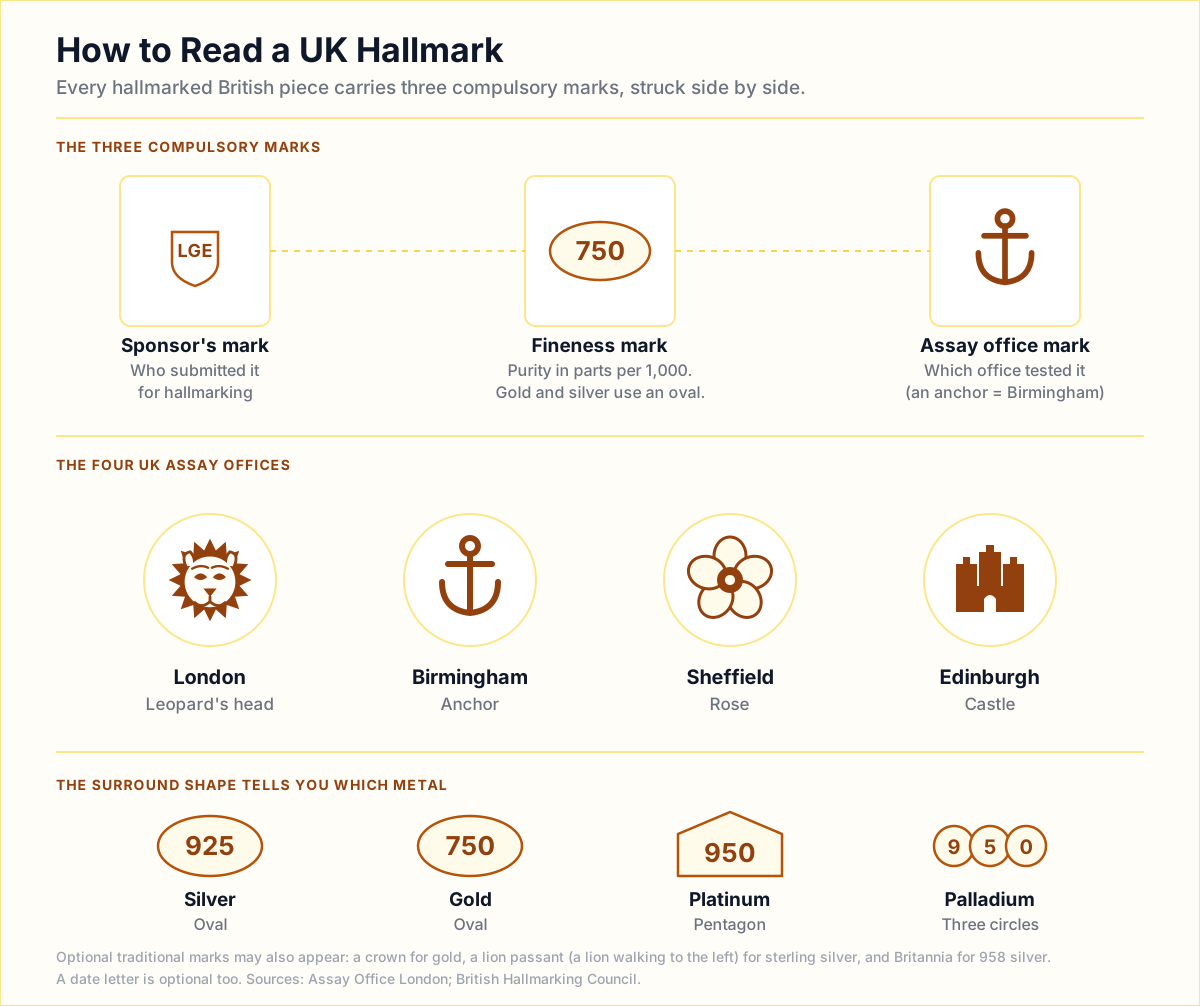
Gold hallmarks are official stamps that guarantee the purity and authenticity of gold items in the UK. Understanding these marks is essential whether you're buying, selling, or valuing gold jewelry. The UK has one of the oldest and most respected hallmarking systems in the world, dating back over 700 years.
This comprehensive guide explains everything you need to know about UK gold hallmarks, from identifying purity marks to spotting fake hallmarks.
What Are Gold Hallmarks?
A hallmark is a legal guarantee stamped onto precious metal items by an independent assay office. Also known as gold markings, hallmarks confirm that the metal has been tested and meets the purity claimed. In the UK, it's illegal to describe an item as gold unless it's hallmarked (with some exceptions for items under 1 gram). This gold markings guide explains how to read and identify every mark on your gold jewellery.
- ✓Consumer Protection - Guarantees you're getting genuine gold at stated purity
- ✓Accurate Valuation - Essential for calculating gold's true worth
- ✓Selling Confidence - Buyers pay more for properly hallmarked items
- ✓Historical Record - Date letters show when items were made
- •Items over 1 gram must be hallmarked to be sold as gold1
- •Governed by the Hallmarking Act 1973
- •Penalties for selling unhallmarked gold as genuine
- •Antique items (pre-1973) may have different markings
History of UK Hallmarking
The UK's hallmarking system is one of the oldest forms of consumer protection in the world. It predates the formation of the United States by over 400 years.
Edward I decreed that all silver must be of sterling standard and marked by wardens
The London Assay Office was established at Goldsmiths' Hall (origin of "hallmark")
Annual date letters began to track when items were marked
Matthew Boulton successfully petitioned for assay offices outside London
Modern legislation consolidating and updating hallmarking law
Date letters became optional; simplified hallmark format introduced
In October 2025 the government set out plans to abolish the British Hallmarking Council, move oversight to the Department for Business and Trade (DBT), modernise the Hallmarking Act 1973, and tighten enforcement against unhallmarked gold sold on online marketplaces. These are proposals under review, not yet law — current hallmarking rules still apply in full.
The Four UK Assay Offices
The UK has four official assay offices authorised to test and hallmark precious metals. Each has a distinctive symbol that appears on hallmarked items.
Leopard's Head
The oldest assay office, established by royal charter. The leopard's head symbolises the city of London.
Goldsmiths' Hall, London EC2
Anchor
The busiest assay office, handling millions of items annually. The anchor represents the city's industrial heritage.
Moreton Street, Birmingham
Rose (York Rose)
Famous for hallmarking silverware. The rose symbolises Yorkshire and the city's heritage.
Guardians' Hall, Sheffield
Castle
Scotland's only assay office. The castle represents Edinburgh Castle and Scottish heritage.
Goldsmiths' Hall, Edinburgh
Historical Assay Offices (Now Closed)
- • Chester (closed 1962) - Three wheat sheaves and a sword
- • Exeter (closed 1883) - Three-towered castle
- • Norwich (closed 1702) - Castle over a lion
- • Newcastle (closed 1884) - Three castles
- • York (closed 1858) - Five lions on a cross
- • Glasgow (closed 1964) - Tree, fish, bird and bell
How to Read a UK Gold Hallmark
A complete UK hallmark contains up to four marks. Modern hallmarks (since 1999) may have fewer components.
1. Sponsor's Mark (Maker's Mark)
The initials of the manufacturer or retailer in a distinctive shield shape. This identifies who is responsible for the item and submitted it for hallmarking.
Example: "ABC" in a shield = ABC Jewellers Ltd
2. Standard Mark (Purity)
A three-digit number showing gold content in parts per thousand. This is the most important mark for determining value.
Example: "750" = 75% pure gold (18 carat)
3. Assay Office Mark
The symbol of the assay office that tested and marked the item. Shows where the gold was officially verified.
Example: Leopard's head = London Assay Office
4. Date Letter (Optional since 1999)
A letter indicating the year the item was hallmarked. Letters cycle through the alphabet in different fonts.
Example: "a" in a specific font = 2000
Gold Purity Marks Explained
The purity mark (fineness mark) shows the gold content as parts per thousand. Here are the standard UK gold purity marks:
| Number | Carat | Gold % | Prevalence | Description |
|---|---|---|---|---|
| 375 | 9 carat | 37.5% | Very Common | The most popular gold purity in the UK. Durable and affordable, ideal for everyday wear. |
| 585 | 14 carat | 58.5% | Common | Popular for engagement rings and fine jewelry. Good balance of purity and durability. |
| 750 | 18 carat | 75% | Common | Premium jewelry standard. Rich gold colour with good durability. Popular for wedding rings. |
| 916 | 22 carat | 91.6% | Less Common | Very high purity. Common in Asian jewelry and traditional gold coins like Sovereigns. |
| 999 | 24 carat | 99.9% | Rare in Jewelry | Pure gold. Too soft for most jewelry, mainly used for investment bars and coins. |
Understanding "Carat" vs "Karat"
In the UK, we use carat (abbreviated "ct") to measure gold purity. The US uses "karat" (abbreviated "K" or "kt"). 24 carat = 24 karat = pure gold. The calculation is simple: divide the carat by 24 to get the percentage of pure gold.
Where to Find Hallmarks on Jewelry
- •Rings
Inside the band, usually opposite any stones
- •Necklaces & Chains
On or near the clasp, sometimes on a small tag
- •Bracelets
Near the clasp or on a flat section of the bracelet
- •Earrings
On the post, butterfly back, or back of the earring
- •Pendants
On the back, bail (loop), or hidden edge
- •Watches
Inside the case back, on lugs, or bracelet clasp
- 1.Use a jeweller's loupe (10x magnification) or magnifying glass
- 2.Good lighting is essential - use a bright lamp or daylight
- 3.Your phone camera's macro mode can help magnify small marks
- 4.Clean the item gently - dirt can obscure hallmarks
- 5.Look in concealed areas where marks won't affect appearance
Pro Tip
Worn hallmarks on older pieces may be legitimate - decades of wear can fade marks. Have such items professionally tested.
How to Identify Fake or Missing Hallmarks
Warning Signs of Fake Hallmarks:
- !Blurry or Poorly Defined Marks
Genuine hallmarks are crisp and clear
- !Incorrect Symbols
Made-up symbols that don't match official assay office marks
- !Missing Components
Genuine hallmarks have multiple marks together
- !Unusual Placement
Marks in strange locations or on plated surfaces
- !"Gold" Without Numbers
Just stamped "GOLD" without purity mark is suspicious
What If There's No Hallmark?
Unhallmarked gold isn't necessarily fake, but caution is advised:
- • Items under 1 gram don't require hallmarking
- • Foreign jewelry may have different marking systems
- • Very old items (pre-1973) may have worn marks
- • Some antique pieces were never hallmarked
Always Get Unmarked Gold Tested
Reputable buyers will test unmarked items with XRF or acid testing. Never accept claims of gold content without verification.
Foreign Gold Marks You May See
Gold jewelry from other countries uses different marking systems. Here are common marks you may encounter:
- 10K = 41.7% gold
- 14K = 58.5% gold (= UK 585)
- 18K = 75% gold (= UK 750)
- 24K = 99.9% gold (= UK 999)
Note: US uses "K" for karat; UK uses "ct" for carat
- 333 = 8 carat (German)
- 375 = 9 carat
- 585 = 14 carat
- 750 = 18 carat
EU uses same numeric system as UK
- 916 = 22ct (common in India, Middle East)
- 999.9 = Pure gold (Swiss bars)
- KP = Karat Plumb (exact karat)
- GF = Gold Filled (not solid gold)
GP/GEP = Gold Plated (minimal gold content)
Frequently Asked Questions
What do the numbers on gold hallmarks mean?
The numbers represent gold purity in parts per thousand. For example, 750 means 750 parts per 1000 are pure gold (75%), which equals 18 carat gold. Common numbers are 375 (9ct), 585 (14ct), 750 (18ct), 916 (22ct), and 999 (24ct/pure gold).
Can I get unhallmarked gold hallmarked?
Yes! Any of the four UK assay offices can test and hallmark your gold. You'll need to submit the item through a registered sponsor (jeweller) or become a sponsor yourself. Fees typically start around £5-10 per item for standard hallmarking.
Is it legal to sell gold without a hallmark?
Items under 1 gram are exempt from hallmarking. For items over 1 gram, it's illegal to describe or sell them as gold unless they're hallmarked. You can sell unmarked items as "yellow metal" but cannot claim they're gold without official hallmarks.
What is the leopard's head hallmark?
The leopard's head is the symbol of the London Assay Office, the oldest in the UK (established 1327). If your gold has a leopard's head mark, it was tested and hallmarked in London. The crowned leopard's head historically indicated 22ct gold.
How can I tell if a hallmark is fake?
Genuine hallmarks are crisp and clearly defined. Look for: blurry marks, incorrect symbols, missing components, unusual placement, or "GOLD" stamps without numbers. When in doubt, have the item professionally tested. The four UK assay offices offer testing services.
Why does my gold have a crown mark?
The crown was traditionally used to denote gold (as opposed to silver or platinum). It was discontinued in 1999 as part of hallmarking simplification. If your item has a crown, it was likely hallmarked before 1999.
What if my hallmark is worn and unreadable?
Worn hallmarks on genuine gold items are common, especially on rings and bracelets worn daily. This doesn't affect the gold's value. Have the item professionally tested if you need to confirm purity - electronic XRF testing is non-destructive and accurate.
Do gold coins have hallmarks?
UK gold coins (Sovereigns, Britannias) don't have traditional hallmarks but have their own official stamps indicating authenticity and purity. Investment gold coins are guaranteed by the Royal Mint and don't require assay office hallmarking.
Calculate Your Gold's Value
Now you understand hallmarks, use our calculator to find out what your gold is worth
Related Guides
Understand gold purity, what the numbers mean, and how alloys affect colour and value.
Read Guide →7 reliable methods to test if your gold is real, including the science behind each test.
Read Guide →Complete guide to selling your gold jewelry. Step-by-step process to get the best price.
Read Guide →Calculate your gold ring's worth: scrap vs resale vs auction value explained.
Read Guide →Sources and References
1 The Hallmarking Act 1973 sets out UK hallmarking requirements. Source:legislation.gov.uk
Information about UK assay offices sourced from:London Assay Office,Birmingham Assay Office
Details of the proposed 2025 hallmarking reforms (abolition of the British Hallmarking Council, transfer of oversight to DBT, and modernisation of the Hallmarking Act 1973) sourced from:The Goldsmiths' Company
Last updated: July 2026

Founder & Market Researcher
Taro has been actively investing in precious metals and financial markets for over 15 years. Frustrated by the lack of transparent, accurate gold pricing information in the UK, he built London Gold Exchange as a data-driven resource for fellow investors. The site combines real-time market data, verified dealer information from 242+ UK businesses, and insights drawn from years of hands-on experience in the gold market.
- ✓15+ years investing in precious metals & equities
- ✓Built verified database of 242+ UK gold dealers
- ✓Daily market data analysis and price tracking
Disclaimer: This guide provides general information about UK gold hallmarks. For definitive verification of gold purity, have items tested by a qualified professional or one of the four UK assay offices. Information current as of August 2026.
Explore London Gold Exchange
Free gold calculator, live UK prices, and 242+ verified dealers across the country.
Some links may earn us commission. This does not affect our editorial independence.