
Gold Hallmark Numbers Explained: What 375, 585, 750, 916 & 999 Mean
Found a number stamped on your gold jewellery and wondering what it means? Those three-digit numbers are hallmark fineness marks that tell you exactly how pure your gold is. This guide covers every number you might find, where to look for them, and what your gold is worth.
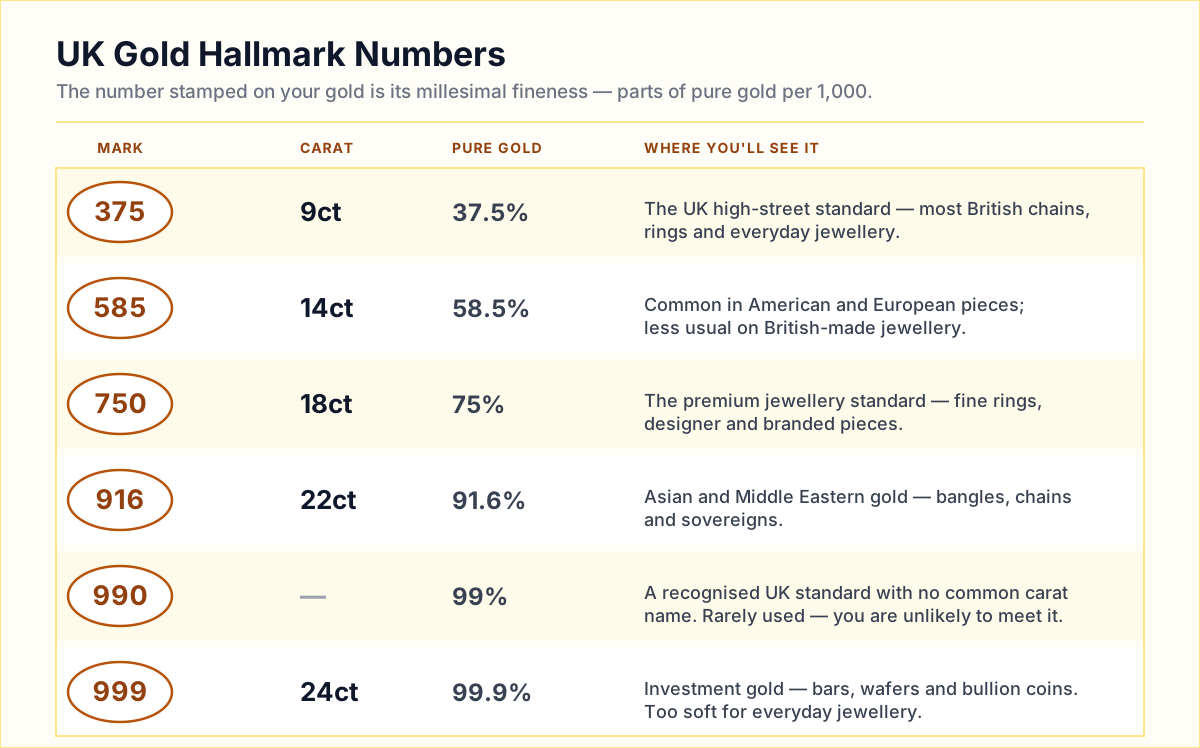
The Quick Answer
- 375 = 9ct gold (37.5% pure) — Most common in UK jewellery
- 585 = 14ct gold (58.5% pure) — Popular in Europe and US
- 750 = 18ct gold (75% pure) — Premium jewellery standard
- 916 = 22ct gold (91.6% pure) — Traditional Asian and Middle Eastern gold
- 990 = 99% pure — A recognised UK standard with no common carat name; rarely used
- 999 = 24ct gold (99.9% pure) — Investment bars and coins
Each number represents parts per thousand of pure gold. So 750 means 750 out of 1,000 parts are gold.
The Millesimal Fineness System
The numbers stamped on gold jewellery use the millesimal fineness system — a way of expressing the purity of precious metals in parts per thousand. A stamp of 750 means that 750 out of every 1,000 parts of the metal are pure gold, with the remaining 250 parts made up of alloy metals.
This system replaced the older carat-only stamp system and has been the international standard for decades. UK Assay Offices officially adopted millesimal fineness as the primary hallmarking standard in 1999, although they had recognised it alongside carat marks for some time before that.
The advantage of millesimal fineness is precision. Rather than saying "18 carat" (which requires knowing that the scale goes to 24), the number 750 tells you directly that the item is 75.0% gold. It is a cleaner, more universal way to communicate purity across borders.
How to Convert Between Systems
Carat to fineness: Divide the carat by 24, then multiply by 1,000. For example, 18ct = (18 / 24) x 1,000 = 750.
Fineness to carat: Divide the fineness by 1,000, then multiply by 24. For example, 375 = (375 / 1,000) x 24 = 9ct.
Found a 375, 585, 750 or 916 mark? Get a quote
Hatton Garden Metals pays about £32.97/g for 375, £51.43/g for 585, £65.94/g for 750 and £80.60/g for 916 today (published 84% of spot) — quote fixed for 2 working days before anything is melted.
Affiliate partner — we may earn a commission at no extra cost to you.
Number-by-Number Breakdown
Here is a detailed look at each hallmark fineness number you are likely to encounter on gold jewellery, coins, and bullion in the UK.
37.5% gold, 62.5% alloy (typically copper, silver, zinc)
Paler yellow than higher purities, can appear slightly warm or greenish depending on alloy mix
- • Everyday UK jewellery
- • Chains and bracelets
- • Wedding bands
- • Earrings and pendants
- ✓ The minimum purity to be legally called "gold" in the UK
- ✓ Most affordable gold jewellery option
- ✓ More durable and scratch-resistant than higher purities
- ✓ By far the most popular purity in UK high-street jewellers
- ✗ Can tarnish over time due to high alloy content
- ✗ Lower resale value per gram
- ✗ May trigger nickel allergies in some wearers
58.5% gold, 41.5% alloy metals
Noticeably richer yellow than 9ct, but lighter than 18ct
- • Engagement rings (US and Europe)
- • Fine jewellery in Germany and Scandinavia
- • Imported designer jewellery
- • Watch cases
- ✓ The standard purity in Germany, Scandinavia, and the US
- ✓ Good balance of purity and durability
- ✓ Popular for engagement rings worldwide
- ✓ Mid-range price point
- ✗ Less common in UK jewellery shops
- ✗ You may see it mainly on imported pieces
75% gold, 25% alloy (silver, copper, palladium, or zinc depending on colour)
Rich, warm yellow (or white/rose depending on alloy). Distinctly more golden than 9ct or 14ct
- • High-end jewellery and designer pieces
- • Luxury watches (Rolex, Omega, Cartier)
- • Engagement and eternity rings
- • Heirloom pieces
- ✓ The premium jewellery standard worldwide
- ✓ Used by Cartier, Tiffany, Rolex, and other luxury brands
- ✓ Excellent resistance to tarnishing
- ✓ Generally hypoallergenic
- ✗ More susceptible to scratching than 9ct or 14ct
- ✗ Significantly more expensive
- ✗ White gold versions may contain nickel
91.6% gold, 8.4% alloy (usually copper and silver)
Deep, rich, unmistakably golden yellow — the colour most people picture when they think of gold
- • South Asian wedding jewellery
- • Middle Eastern gold jewellery
- • Gold Sovereign coins
- • Krugerrand coins
- ✓ Traditional in South Asian and Middle Eastern cultures
- ✓ Gold Sovereigns are 22ct (916 fineness)
- ✓ High resale value due to gold content
- ✓ Sovereigns are CGT-exempt as legal tender
- ✗ Very soft metal — scratches and dents easily
- ✗ Not ideal for stone settings (prongs can bend)
- ✗ Less widely available in UK high-street shops
99.9% pure gold with only trace impurities. Some bars are stamped 999.9 ("four nines fine") at 99.99% purity
Bright, deep, saturated yellow — the purest gold colour possible
- • Investment gold bars (1g to 1kg)
- • Britannia coins (since 2013)
- • Chinese Panda coins
- • Central bank reserves
- ✓ The purest commercially available gold
- ✓ Maximum gold content per gram of weight
- ✓ Britannias are CGT-exempt as legal tender
- ✓ Completely hypoallergenic
- ✗ Too soft for most jewellery — bends and scratches easily
- ✗ Highest price per gram
- ✗ Primarily used for investment, not wearing
Other Numbers You Might See
Not every number stamped on jewellery means what you think. Here are some other stamps you may encounter and what they actually indicate.
| Stamp | Meaning | Notes |
|---|---|---|
| 333 | 8ct gold (33.3% pure) | Legal minimum in Germany and some European countries. Not legal to sell as "gold" in the UK |
| 417 | 10ct gold (41.7% pure) | The minimum standard in the US and Canada. You may find it on imported American jewellery |
| 625 | 15ct gold (62.5% pure) | Historical UK standard, discontinued in 1932. Found on antique and vintage pieces only |
| 990 | 23.76ct gold (99% pure) | Occasionally found on older Asian gold items. Recognised but uncommon in the UK |
| PT950 | Platinum (95% pure) | This is platinum, not gold. Do not confuse PT950 with a gold fineness mark |
| 925 | Sterling silver (92.5% pure) | This is silver, not gold. A gold-coloured item stamped 925 is likely gold-plated silver (vermeil) |
Watch Out for Gold Plating Stamps
Stamps like GP (gold plated), GF (gold filled), GEP (gold electroplated), or RGP (rolled gold plate) do not indicate solid gold. These items have a thin layer of gold over a base metal and have minimal scrap gold value.
Sponsor's Mark / Maker's Mark
Alongside the fineness number, you may see two or three letters — this is the sponsor's mark (also called the maker's mark). It identifies the company or person who submitted the item for hallmarking. For example, "BHJ" might identify a specific Birmingham jeweller. The sponsor's mark doesn't affect value but can help trace the origin of antique pieces.
Date Letters
Many UK hallmarks include a date letter — a single letter that indicates the year the item was hallmarked. The letter style and font changes annually, and each Assay Office uses its own date letter sequence. For example, a lowercase "a" in a specific font at the Birmingham Assay Office might indicate 1998. Date letters can help you determine the age of a piece, which matters for antique valuation. Since 1999, date letters became optional — many modern pieces only show the fineness number and Assay Office mark.
Where to Find the Number on Your Jewellery
Hallmarks are small — often just 1-2mm across — so you may need a magnifying glass or jeweller's loupe to read them clearly. Here is where to look on different types of jewellery.
Check the inside of the band. The hallmark is usually stamped on the inner surface, opposite the setting if the ring has a stone. On wider bands, it may be near the bottom of the inner curve.
Look near the clasp — either on a small tag attached to the clasp, on the clasp itself, or on the jump ring connecting the chain to the clasp. Some chains have the stamp on the first link near the fastening.
Check on or near the clasp, or on a flat link close to the clasp. Bangles may have the hallmark stamped on the inside surface, similar to a ring.
Look on the post (the part that goes through your ear) or on the butterfly back. Stud earrings may have the mark on the flat back surface. Drop earrings often have it near the hook or hinge.
Gold watch cases are typically hallmarked on the inside of the case back. You may need to have the back removed by a jeweller. Some also have marks on the inside of the clasp on the bracelet.
If you cannot find a hallmark, the item may be very old (pre-hallmarking requirements), foreign (not all countries require hallmarks), under 1g (exempt from UK hallmarking), or potentially not real gold. Consider having it tested by a professional.
Tip: Use Your Phone Camera
If you do not have a magnifying glass, use your smartphone camera in macro mode or simply take a close-up photo and zoom in. Many modern phone cameras can capture enough detail to read even the smallest hallmarks.
What Your Gold Is Worth by Fineness
The fineness number directly determines the value of your gold per gram. Here are approximate prices based on current market rates. These figures represent the pure gold value — actual dealer offers will vary.
| Fineness | Carat | Gold Content | Approx. Value per Gram |
|---|---|---|---|
| 375 | 9ct | 37.5% | ~£25-28 |
| 585 | 14ct | 58.5% | ~£39-43 |
| 750 | 18ct | 75% | ~£50-55 |
| 916 | 22ct | 91.6% | ~£61-67 |
| 999 | 24ct | 99.9% | ~£67-73 |
Prices Change Daily
The values above are approximate guides only. Gold prices fluctuate throughout every trading day based on global market conditions. For today's exact price per gram at any purity, use our gold calculator which pulls live pricing data.
Hallmark Numbers vs Carat Stamps
You might find either a three-digit number or a carat stamp on your gold — or sometimes both. These are two different systems for communicating the same information: purity.
Traditionally, gold items in the UK were stamped with carat marks like "9ct", "18ct", or "22ct". This system uses a scale of 24, where 24ct represents pure gold. Some older pieces may also show "9" or "18" alongside the crown and assay office mark.
- • Used in the UK for centuries
- • Still legally valid on UK gold
- • Common on pre-1999 items
- • Familiar to most people
Since 1999, UK Assay Offices have primarily used the millesimal fineness system: 375, 585, 750, 916, 999. These numbers show parts per thousand of pure gold and are the international standard.
- • International standard since 1999
- • More precise than carat system
- • Universally understood across borders
- • Found on all modern UK-hallmarked gold
| Carat Stamp | Fineness Number | Pure Gold % | Where You'll See It |
|---|---|---|---|
| 9ct | 375 | 37.5% | Most UK everyday jewellery |
| 14ct | 585 | 58.5% | Imported European and American pieces |
| 18ct | 750 | 75% | Premium and luxury jewellery |
| 22ct | 916 | 91.6% | Sovereigns, Asian jewellery |
| 24ct | 999 | 99.9% | Investment bars and coins |
Both stamping systems are legally valid in the UK. If you have an older piece with a carat mark but no fineness number, it is still legitimate hallmarked gold. Many items produced since 1999 will carry the fineness number as the primary mark, and some pieces carry both.
Is My Gold Real? How to Verify
A hallmark from a UK Assay Office is the most reliable way to confirm that your gold is genuine and of the stated purity. The UK has four active Assay Offices, each with a distinctive symbol that appears alongside the fineness number.
- AnchorBirmingham Assay Office — the busiest in the UK, hallmarking millions of items annually
- Leopard's HeadLondon Assay Office (Goldsmiths' Hall) — the oldest, dating back to 1300
- CastleEdinburgh Assay Office — serving Scotland
- RoseSheffield Assay Office — historically associated with silver and cutlery
- •Under 1 gram: Items below 1g are exempt from compulsory hallmarking in the UK
- •Pre-1999 items: May only have carat stamps without fineness numbers
- •Foreign imports: Not all countries require hallmarking; some use different systems
- •Worn off: On very old or heavily worn pieces, the hallmark may have faded
Laser Hallmarking
Since the early 2000s, UK Assay Offices have increasingly used laser hallmarking alongside traditional punch hallmarks. Laser marks are smaller and more precise, making them ideal for delicate jewellery. They contain the same information as traditional marks but may require a stronger magnifying glass to read.
Want to Test Your Gold at Home?
If your item lacks a hallmark or you want extra reassurance, there are several methods you can use at home to check if gold is real. See our detailed guide: How to Test Gold at Home.
Frequently Asked Questions
Is 375 real gold?
Yes, 375 means 9 carat gold, which is 37.5% pure gold. It is the legal minimum purity to be sold as "gold" in the UK under the Hallmarking Act 1973. The remaining 62.5% is made up of alloy metals such as copper, silver, and zinc, which give the gold greater durability and scratch resistance.
What's worth more, 585 or 750?
750 (18ct) gold is worth more per gram because it contains 75% pure gold compared to 58.5% in 585 (14ct) gold. Per gram of total weight, 18ct gold is roughly 28% more valuable than 14ct. If you are selling, the fineness number directly determines the price a dealer will offer per gram.
Why is my gold stamped 750 but looks white or rose coloured?
The 750 stamp tells you the gold purity — 75% pure gold — not the colour. The colour depends entirely on the alloy metals mixed with the gold. Palladium or nickel creates white gold, a high proportion of copper creates rose gold, and a balanced mix of copper and silver creates traditional yellow gold. All three colours can be 750 fineness.
Is 916 gold better than 750?
It depends on what you mean by "better." 916 (22ct) gold has a higher purity and therefore more gold content per gram, giving it a higher resale value and a richer yellow colour. However, it is significantly softer than 750 (18ct) and more prone to scratching and denting. For everyday jewellery, 750 is usually the better practical choice. For investment or special cultural jewellery, 916 may be preferred.
Can gold be 100% pure?
Commercially, the purest gold available is 999.9 fine — 99.99% pure, known as "four nines fine." True 100% purity is not achievable at an industrial scale because trace amounts of other elements remain even after extensive refining. For all practical purposes, 999.9 gold is as pure as gold gets, and it is this standard used for the highest-quality investment bars.
My gold has no hallmark — is it fake?
Not necessarily. There are several legitimate reasons why genuine gold may lack a hallmark. Items weighing under 1 gram are exempt from compulsory UK hallmarking. Very old pieces may only carry carat stamps from before the fineness system was adopted. Some imported jewellery from countries without hallmarking requirements may also be unmarked. That said, the absence of any identifying mark is a good reason to have the item professionally tested before assuming it is genuine gold.
What does the anchor, lion, or castle mark mean next to the number?
These are UK Assay Office marks that confirm where the gold was officially tested and hallmarked. The anchor represents Birmingham, the leopard's head represents London, the castle represents Edinburgh, and the rose represents Sheffield. Seeing one of these marks alongside a fineness number is strong confirmation that the gold has been independently verified to be of the stated purity.
Should I sell my 375 gold or keep it?
9ct (375) gold has a lower resale value per gram than higher purities because only 37.5% of its weight is actual gold. However, it is still valuable — especially in larger quantities or heavier pieces. Whether to sell depends on current gold prices, your financial situation, and any sentimental attachment. Use our gold calculator to check today's exact value before making a decision.
Find Out What Your Gold Is Worth
Now you know what the numbers mean, check your gold's value with today's live prices
Related Guides
Learn to read hallmarks, identify assay office symbols, and verify authenticity.
Read Guide →9ct vs 18ct vs 24ct — understand carats, alloy chemistry, and which purity suits your needs.
Read Guide →Simple tests you can do at home to check if your gold is real, from magnet tests to acid kits.
Read Guide →Calculate your gold's value with live UK prices. Enter weight and purity for an instant valuation.
Calculate Now →Today's live 9ct (375) gold price per gram in the UK, with historical charts and trends.
Check Price →Today's live 18ct (750) gold price per gram in the UK, with historical charts and trends.
Check Price →Sources and References
UK hallmarking standards: The Hallmarking Act 1973. Source:legislation.gov.uk
Assay office information:London Assay Office,Birmingham Assay Office
Millesimal fineness system:British Hallmarking Council
Last updated: 17 September 2026

Founder & Market Researcher
Taro has been actively investing in precious metals and financial markets for over 15 years. Frustrated by the lack of transparent, accurate gold pricing information in the UK, he built London Gold Exchange as a data-driven resource for fellow investors. The site combines real-time market data, verified dealer information from 242+ UK businesses, and insights drawn from years of hands-on experience in the gold market.
- ✓15+ years investing in precious metals & equities
- ✓Built verified database of 242+ UK gold dealers
- ✓Daily market data analysis and price tracking
Disclaimer: This guide provides general information about gold hallmark fineness numbers. Actual gold values depend on current market prices and dealer rates. Prices shown are approximate and change daily. For accurate valuations, use our calculator with live prices or consult a professional gold dealer. This content does not constitute financial advice. Information current as of March 2026.
Explore London Gold Exchange
Free gold calculator, live UK prices, and 242+ verified dealers across the country.
Some links may earn us commission. This does not affect our editorial independence.