
Silver Hallmarks UK Guide: How to Read & Identify Silver Marks
A complete guide to understanding UK silver hallmarks. Learn to identify the lion passant, Britannia mark, assay office symbols, and how to tell solid silver from silver plate.
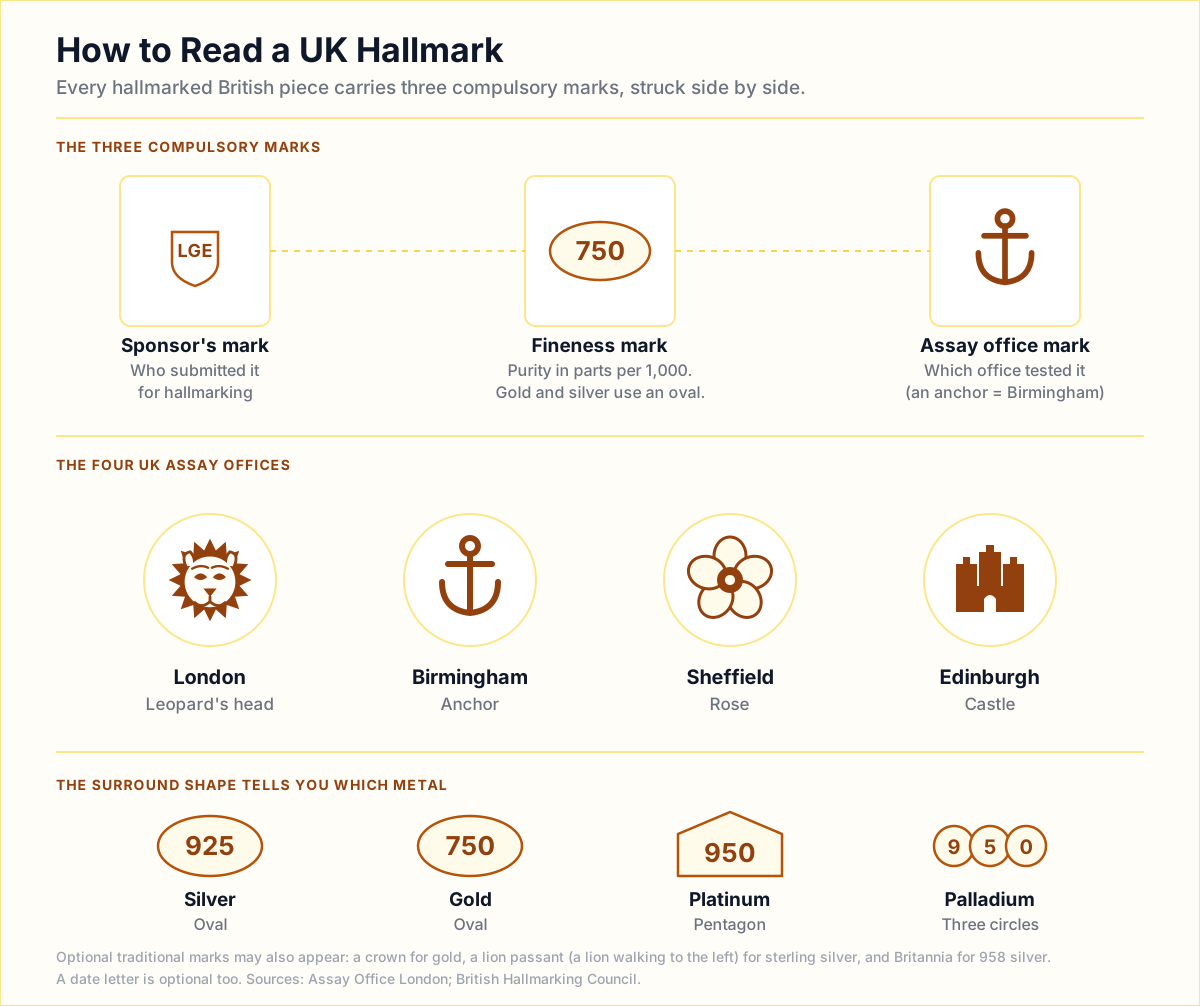
Silver hallmarks are official stamps that guarantee the purity and authenticity of silver items in the UK. Whether you're buying jewellery, valuing inherited silverware, or looking to sell silver for its melt value, understanding hallmarks is essential. The UK hallmarking system for silver dates back over 700 years and remains one of the strongest consumer protections in the world.
This guide covers everything you need to know: the four-part hallmark system, the difference between sterling (925) and Britannia (958) silver, all four current assay office marks, and how to tell solid silver from plated items.
What Are Silver Hallmarks?
A hallmark is a legal guarantee stamped onto precious metal items by an independent assay office. It confirms that the metal has been tested and meets the purity claimed. In the UK, it's illegal to describe an item weighing 7.78 grams or more as silver unless it carries a hallmark (under the Hallmarking Act 1973).
- ✓Consumer Protection — Guarantees genuine silver at the stated purity
- ✓Accurate Valuation — Essential for calculating silver's true melt value
- ✓Resale Confidence — Hallmarked silver commands higher prices from buyers
- ✓Dating & Provenance — Date letters and assay marks reveal an item's history
- •Items of 7.78 grams or more must be hallmarked to be sold as silver
- •Governed by the Hallmarking Act 1973 (amended 1998)
- •Penalties for selling unhallmarked silver as genuine
- •Antique items (pre-1973) may have different markings
- •Silver's 7.78g threshold is higher than gold's 1g, so light silver items are often unmarked
How to Read a UK Silver Hallmark
A complete UK silver hallmark contains up to four marks stamped side by side. Since 1999, date letters have been optional, so modern hallmarks may have three or four components.
1. Sponsor's Mark (Maker's Mark)
The initials of the manufacturer or retailer in a distinctive shield shape. This identifies who submitted the item for hallmarking.
Example: "JS" in an oval = J. Smith Silversmiths
2. Standard Mark (Purity)
For sterling silver (925), this is the lion passant — a walking lion facing left. For Britannia silver (958), it's the figure of Britannia. Edinburgh marks 925 with a lion rampant (a thistle before 1975).
Since 1999, the numeric fineness (925, 958) may also appear
3. Assay Office Mark
The symbol of the assay office that tested and marked the item: leopard's head (London), anchor (Birmingham), rose (Sheffield), or castle (Edinburgh).
Example: Anchor = Birmingham Assay Office
4. Date Letter (Optional since 1999)
A letter indicating the year the item was hallmarked. Each assay office historically used its own cycle of letters and fonts.
Now optional — most modern items omit it
Sell hallmarked silver by insured post
Hatton Garden Metals buys sterling and Britannia silver at rates based on the live silver price.
Affiliate partner — we may earn a commission at no extra cost to you.
UK Assay Office Marks for Silver
The UK has four official assay offices authorised to test and hallmark silver. Each has a distinctive symbol that appears on hallmarked items.
Leopard's Head
Lion passant + leopard's head
The oldest assay office, established by royal charter. The leopard's head symbolises the City of London.
Anchor
Lion passant + anchor
The busiest assay office, hallmarking millions of items per year. The anchor represents the city's industrial heritage.
Rose (York Rose)
Lion passant + rose
Historically famous for Sheffield plate and silverware. The rose symbolises Yorkshire.
Castle
Thistle + castle
Scotland's only assay office. Marks sterling with a lion rampant instead of the lion passant (a thistle before 1975).
Historical Assay Offices (Now Closed)
If your silver carries one of these marks, it was hallmarked before the office closed — making it a dateable antique:
- • Chester (closed 1962) — Three wheat sheaves and a sword
- • Glasgow (closed 1964) — Tree, fish, bird and bell
- • Newcastle (closed 1884) — Three castles
- • Exeter (closed 1883) — Three-towered castle
- • Norwich (closed 1702) — Castle over a lion
- • York (closed 1858) — Five lions on a cross
Silver Purity Marks Explained
The standard mark tells you the purity of the silver. Here are the silver purity grades you'll encounter in the UK:
| Fineness | Name | Silver % | Traditional Mark | Common Use |
|---|---|---|---|---|
| 999 | Fine Silver | 99.9% | 999 numeral | Investment bars and coins, bullion products |
| 958 | Britannia Silver | 95.8% | Figure of Britannia | High-end silverware, commemorative items, historical pieces (1697-1720) |
| 925 | Sterling Silver | 92.5% | Lion passant (England) / Thistle (Scotland) | Most UK silver jewellery, cutlery, tableware |
| 800 | Continental Silver | 80.0% | 800 numeral | Common European standard (Germany, Italy, etc.) |
Lion Passant vs Britannia Mark
The lion passant (a lion walking to the left) is the standard mark for 925 sterling silver in England. The figure of Britannia (a seated female figure) indicates the higher 958 purity. Between 1697 and 1720, Britannia silver was the only legal standard — making pieces from that period historically significant.
How to Identify Silver Without a Hallmark
Not all silver items carry hallmarks — they may be under the 7.78g threshold, foreign-made, or simply very old. Here are practical tests you can do at home:
- 1. Magnet Test
Silver is not magnetic. If a strong magnet sticks to your item, it contains iron or steel and is not solid silver. Note: non-magnetic metals like copper and brass also won't stick, so this test only rules items out.
- 2. Ice Test
Silver is the best thermal conductor of any metal. Place an ice cube on the item — if it melts noticeably faster than on a ceramic plate, it's likely real silver.
- 3. Ring/Ping Test
Tap a silver coin or flat item gently. Real silver produces a clear, high-pitched ring that sustains for 1-2 seconds. Plated or base metal items produce a dull thud.
- 4. Acid Test (Destructive)
A drop of silver testing acid on a scratch mark changes colour depending on purity. This leaves a small mark, so it's best done by a professional in an inconspicuous area.
- 5. XRF Analysis (Non-Destructive)
X-ray fluorescence scanners give an exact purity reading without damaging the item. Available at assay offices and specialist dealers. This is the gold standard for silver testing.
- 6. Specific Gravity Test
By weighing the item in air and in water, you can calculate its density. Pure silver has a specific gravity of 10.49 — significantly different from common substitute metals.
Common Silver Marks from Other Countries
Silver from other countries uses different marking systems. Here are common marks you may encounter on imported or antique silver:
- 800 — Continental silver (Germany, Italy)
- 830 — Scandinavian standard
- 925 — Sterling (same as UK)
- 950 — French first standard
- Minerva head — French hallmark
EU countries use the Vienna Convention mark (scales) for cross-border recognition
- STERLING — 92.5% silver
- 925 — Same as sterling
- COIN — 90% silver (from coin silver)
- 900 — 90% silver
The US has no compulsory hallmarking system — marks are voluntary
- Silver/950 — Japanese standard
- 925 in a circle — Common Asian mark
- 84 (zolotnik) — Russian imperial (= 875)
- Kokoshnik mark — Russian hallmark
Russian zolotnik system: 84 = 875, 88 = 916, 91 = 947
Silver-Plated vs Solid Silver: How to Tell the Difference
This is the most important distinction when valuing silver items. Silver plate has minimal scrap value, while solid silver can be worth significantly more.
Signs of Silver Plate (Low Value):
- !EPNS
Electro Plated Nickel Silver — the most common plate mark
- !EP, EPBM, EPWM
Electro Plated (on Britannia Metal, White Metal)
- !A1 or AI
First-quality plate (thick plating, but still plate)
- !Sheffield Plate / Old Sheffield Plate
Silver fused to copper — pre-dates electroplating. Can have antique value
- !Copper showing through
Worn areas showing a different colour metal beneath
Signs of Solid Silver (Valuable):
- ✓Lion Passant Mark
The walking lion confirms 925 sterling silver
- ✓925, 958, or 999 Stamp
Numeric purity mark with assay office symbol
- ✓Full Hallmark Set
Sponsor's mark + purity mark + assay office mark together
- ✓Consistent Colour Throughout
No different-coloured metal showing through worn areas
How to Authenticate Silver Coins Purchased Online UK
Silver coins bought online in the UK should be authenticated using hallmarks, weight verification, and dimensional checks. Genuine Royal Mint Silver Britannias weigh exactly 31.1035 grams, measure 38.61 mm in diameter, and carry a 999 purity mark. Any deviation suggests a counterfeit. Here are the key verification steps for silver coins purchased online:
- 1. Weigh the coin — use a digital scale accurate to 0.01g. A genuine 1 oz silver coin should weigh 31.10 g (±0.05g).
- 2. Measure diameter and thickness — digital callipers are ideal. Compare against Royal Mint specifications.
- 3. Perform the ping test — tap the coin gently and listen for a clear, sustained ring. Real silver resonates for 1-2 seconds.
- 4. Use a magnet — silver is not magnetic. If a neodymium magnet sticks, the coin is fake.
- XRF scan — any UK assay office or specialist dealer can perform a non-destructive X-ray fluorescence test confirming exact purity.
- Buy from reputable sources — purchase from Royal Mint authorised distributors, LBMA-approved dealers, or use our verified dealer directory.
- Check packaging — genuine bullion from major dealers comes in tamper-evident capsules or sealed tubes with serial numbers.
What Is My Hallmarked Silver Worth?
Once you've identified your silver's hallmark and purity, you can calculate its melt value using today's live silver price.
Worked Example: 925 Sterling Silver Bracelet
You have a hallmarked sterling silver bracelet weighing 30 grams:
Fine silver price today
£1.47/g
Sterling melt value (92.5%)
£40.79
Specialist postal buyer (~70%)
£28.55
Calculation: 30g × £1.47 × 0.925 = £40.79 melt value
Frequently Asked Questions
What does a lion passant hallmark mean on silver?
The lion passant (a walking lion facing left) is the traditional standard mark for 925 sterling silver in England. It guarantees the item is at least 92.5% pure silver. Sterling silver marked in Edinburgh carries a lion rampant instead; before 1975 Scottish sterling used a thistle.
What weight must silver be to require a hallmark in the UK?
Silver items weighing 7.78 grams or more must be hallmarked to be sold as silver in the UK under the Hallmarking Act 1973. Items under 7.78 grams are exempt. This is higher than the gold exemption threshold of 1 gram.
How can I tell if silver is real without a hallmark?
Use the magnet test (silver is not magnetic), the ice test (ice melts rapidly on silver due to its high thermal conductivity), or the ring test (real silver produces a sustained high-pitched ring). For accurate results, have the item professionally tested with XRF analysis at a verified dealer or assay office.
What is the difference between 925 and 958 silver?
925 (sterling silver) contains 92.5% pure silver and is the most common standard for UK silver items. 958 (Britannia silver) contains 95.8% pure silver and is a higher purity standard historically required by law from 1697 to 1720.
What does EPNS mean on silver?
EPNS stands for Electro Plated Nickel Silver. It means the item is not solid silver — it is a base metal (nickel silver, which contains no actual silver) coated with a thin layer of real silver through electroplating. EPNS items have minimal scrap silver value.
Can I get unmarked silver hallmarked?
Yes. Any of the four UK assay offices (London, Birmingham, Sheffield, Edinburgh) can test and hallmark silver items. You submit the item through a registered sponsor or become a sponsor yourself. Fees start from around £3-5 per item for standard hallmarking.
Calculate Your Silver's Value
Now you understand hallmarks, use our calculator to find out what your silver is worth at today's live prices
Buying hallmarked silver rather than selling?
Now you can read a hallmark, TJC is a UK retailer selling sterling silver jewellery direct — useful for checking what a marked piece costs new.
Affiliate partner — we may earn a commission at no extra cost to you.
Related Guides
Complete guide to reading gold hallmarks, purity marks, and assay office symbols.
Read Guide →Today's live scrap silver prices with dealer payout tables for all purities.
Check Prices →How to sell silver for the best price — dealer rates, AML documents, and tax implications.
Read Guide →Value, CGT exemption, and buying guide for Royal Mint Silver Britannia coins.
Read Guide →Sources and References
The Hallmarking Act 1973 sets out UK hallmarking requirements for silver. Source:legislation.gov.uk
Information about UK assay offices sourced from:London Assay Office,Birmingham Assay Office
Last updated: 22 September 2026

Founder & Market Researcher
Taro has been actively investing in precious metals and financial markets for over 15 years. Frustrated by the lack of transparent, accurate gold pricing information in the UK, he built London Gold Exchange as a data-driven resource for fellow investors. The site combines real-time market data, verified dealer information from 242+ UK businesses, and insights drawn from years of hands-on experience in the gold market.
- ✓15+ years investing in precious metals & equities
- ✓Built verified database of 242+ UK gold dealers
- ✓Daily market data analysis and price tracking
Disclaimer: This guide provides general information about UK silver hallmarks. For definitive verification of silver purity, have items tested by a qualified professional or one of the four UK assay offices. Silver prices shown are based on live LBMA data and change daily. Information current as of September 2026.
Explore London Gold Exchange
Free gold calculator, live UK prices, and 242+ verified dealers across the country.
Some links may earn us commission. This does not affect our editorial independence.